

Before you buy in Jacó, Herradura, Punta Leona, or any other area of Costa Rica, you need to understand the legal differences between the types of communities available. One offers security and structure; the other can lead to neighborhood disputes.
When you start browsing real estate listings in Costa Rica’s beautiful Central Pacific region, you will constantly see the word “Condominium.”
If you are from North America or Europe, you probably associate “condo” solely with an apartment in a high-rise tower. However, in Costa Rica, the term “Condominium” refers to a specific legal structure under the Ley Reguladora de la Propiedad en Condominio (Law 7933), not just the architectural style of the building.
Understanding this law is crucial because it dictates what you own, what you are responsible for maintaining, and what rules you must follow.
Furthermore, many buyers confuse true condominiums with regular “gated neighborhoods” (often called Residenciales), not realizing that the lack of a legal structure in the latter can lead to serious headaches regarding security and fees.
As your trusted advisors at Pacific Dreams Realty, we want to break down these differences so you can buy with confidence.
The Two Types of Legal Condominiums in Costa Rica
In Costa Rica, if a property is part of a registered condominium, you own your private unit (called a finca filial), and you share ownership of common areas with your neighbors. But how that ownership is structured depends on whether it is “vertical” or “horizontal.”
1. The Vertical Condominium (Condominio Vertical)
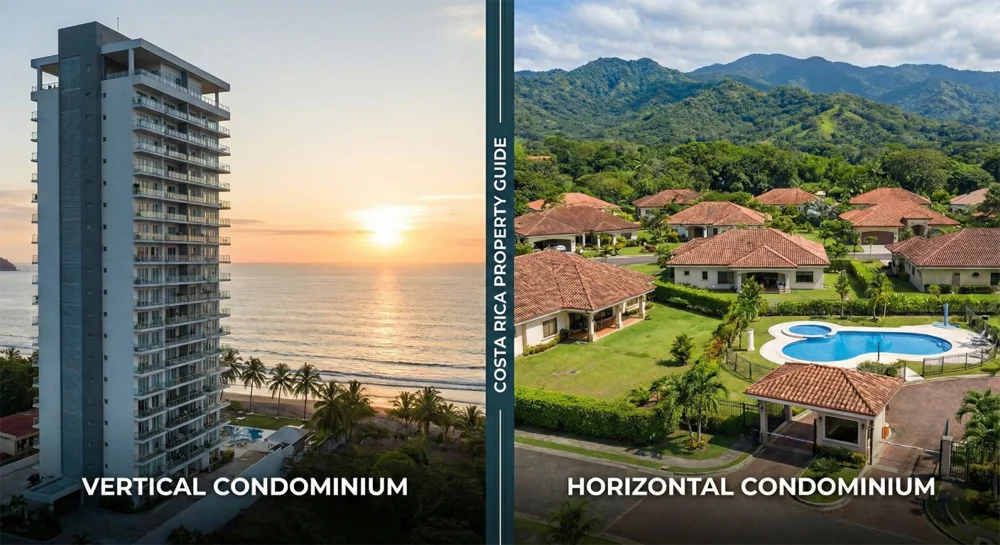
This is what most people traditionally think of as a condo. These are multi-story buildings where units are stacked on top of each other. Think of the beachfront towers along Jacó Beach or the apartment buildings in Jacó Bay.
- What you own: You own the interior space of your apartment “from paint to paint.”
- The Land: You do not individually own the land directly beneath your feet. The footprint of the building and the surrounding grounds are jointly owned by all the unit owners together.
- Maintenance: The Homeowner’s Association (HOA) is usually responsible for the roof, exterior walls, structural foundations, elevators, and all common areas. Your HOA fees cover these large structural expenses.
- Who it’s for: Investors looking for “lock-and-leave” convenience with minimal exterior maintenance responsibilities.
2. The Horizontal Condominium (Condominio Horizontal)
This concept often surprises buyers. You can buy a single-family home with a private yard inside a gated community in Costa Rica, and legally, it is a “condominium.”
- What you own: You own the specific structure of your house y the specific plot of land (footprint) underneath it.
- The Land: You have exclusive rights to your private lot. The “common areas” are the shared amenities like the community pool, the clubhouse, the internal roads, and the security gate.
- Maintenance (The Crucial Difference): In many horizontal condos, because you own your own structure, you are responsible for your own roof, exterior painting, and garden. The HOA fee only covers the shared amenities, not your private home’s exterior. Note: This varies by community bylaws, so always check.
- Who it’s for: Families or retirees who want the privacy of a standalone home and a yard, but also desire the security and amenities of a managed community.
The Importance of Rules and the HOA (Administración)
Whether vertical or horizontal, all legal condominiums in Costa Rica share two things: Common Areas and Bylaws.
1. Common Areas: These are the features that draw you to the community: pools, gyms, rancho BBQ areas, perfectly manicured landscaping, elevators, and, most importantly, 24/7 security gates.
2. The Bylaws (Reglamento de Condominio): To keep those common areas pristine and the community peaceful, every owner must pay mandatory monthly HOA fees (cuotas de mantenimiento).
If you buy into a condo, you are agreeing to abide by the Reglamento. This document rules the community. It dictates:
- If the community is pet-friendly.
- Rules regarding noise and quiet hours.
- Whether you are allowed to do short-term AirBnB-style rentals or only long-term leases.
- Architectural guidelines (in horizontal condos) to ensure, for example, that your neighbor doesn’t build a monstrosity in front of you and blocks all of your beautiful ocean view.
In a legal condominium, if an owner refuses to pay their HOA fees, the administration has legal recourse to place a lien on the property and eventually foreclose to recover the debt. This ensures everyone pays their fair share.
The Danger Zone: “Residenciales” (Non-Condominiums)
This is where many unadvised buyers run into trouble.
You might drive past a nice neighborhood with a guard shack and a boom barrier at the entrance and assume it is a private, secure condominium. But if it is not legally registered under Law 7933, it is simply a “Residencial” or an “Urbanización.”
The Critical Difference: In these neighborhoods, the internal roads and sidewalks are usually public municipal property, not private common areas.
This distinction creates two major problems for owners:
1. The “Voluntary Fee” Problem
In some of these neighborhoods, they might ask for a monthly maintenance fee. Because there is no legal condominium structure, there is no mechanism to force homeowners to pay for upkeep. Neighbors often form a voluntary committee to hire security guards, and some Residenciales even have a common area pool, asking every homeowner to contribute $50 or $100 or even $250 a month to cover these costs.
It works fine—until it doesn’t. When neighbors stop paying (absentee owners, or simply people who refuse), the paying neighbors must cover the difference or fire the guards. There is no legal recourse to collect these fees.
If the Residencial is just a regular neighborhood with no guard and no common area amenities or water source, it shouldn’t have any monthly fees. In this case, you won’t have any issues with this type of problem.
2. The Illusion of Security (Public Roads)
This is the most shocking part for many buyers. In a Residencial, the roads are public.
Even if the neighbors build a guard shack and install a lifting arm/barrier, the security guard has NO legal right to stop any vehicle from entering.
Constitutional law in Costa Rica protects free transit on public roads.
- The guard can ask for ID, but if a driver refuses and demands entry, the guard must let them through.
- The guard cannot deny entry to anyone, including people the neighbors might consider “suspicious.”
In a true Condominium, the roads are private property, and the guards have the legal authority to deny entry to anyone who is not an owner or an authorized guest. In a Residencial, that gate is often just “security theater.”
The Final Verdict
When buying in the Central Pacific, knowing the legal status of your potential property is vital.
- A Condominium (Vertical or Horizontal) offers legal protection, enforceable rules, and true private security where access can be controlled.
- A Residencial offers more freedom and no mandatory HOA, but the security is legally limited, and fees rely entirely on the goodwill of neighbors.
Don’t leave your investment to chance. At Pacific Dreams Realty, we ensure our clients know exactly what they are buying. We review the legal status and the bylaws before you sign on the dotted line.
Are you looking for a secure investment in Jacó or the surrounding areas? Contact us today, and let’s find the right property structure for your needs.



Únete al foro