


Costa Rica’s “Pura Vida” lifestyle, stable democracy, and breathtaking landscapes make it a top destination for investors, retirees, and second-home buyers. But how easy is it to purchase property as a foreigner? This comprehensive guide will walk you through the entire process, from legal requirements to the final closing, ensuring you invest with confidence.
1. Introduction: Why Costa Rica is a Prime Investment Hub
Investing in Costa Rica real estate remains a compelling option. The country’s long-standing political stability, commitment to sustainability (with over 98% of its energy from renewable sources), and world-class ecotourism draw millions of visitors annually.
This translates into a robust real estate market, particularly for vacation rentals, which often see high occupancy rates and strong rental yields. The established expatriate communities, high-quality private healthcare, and the welcoming “Tico” culture make it an easy place to transition, live, or invest.
2. Can Foreigners Legally Buy Property in Costa Rica? (Spoiler: Yes!)
This is the most common question, and the answer is a resounding yes.
The Costa Rican constitution grants foreigners the same property ownership rights as citizens. You can buy, own, and sell property in your personal name with the same legal footing as a local.
The One Major Exception: Concession Property
The only significant restriction lies within the Maritime Terrestrial Zone (ZMT). This is the first 200 meters of beachfront land measured from the high-tide line.
- Public Zone (First 50 meters): This land is public and cannot be owned by anyone.
- Restricted Zone (Next 150 meters): This land is owned by the government and can only be leased through a government “concession” through the local municipality. While foreigners can lease this land, there are restrictions. If you are not a legal resident, you can typically only own up to 49% of the concession rights.
An Important Note on Titled Beachfront: There is a significant exception to this rule. In areas that were developed and titled before the ZMT law was enacted in 1977, properties can be fully titled right up to the 50-meter public zone. Most beachfront and oceanfront properties in high-development areas like Jaco and the Garabito canton are fully titled and do not fall under the concession rule.
For a straightforward purchase, it is highly recommended to buy titled property (known as “Fee Simple”), which gives you absolute ownership.
3. Step-by-Step Buying Process
Navigating the purchase requires a clear, methodical approach. Here is the proven path to a secure transaction.
Step 1: Finding a Reputable Real Estate Agent
A professional, reputable agent is your most important ally. It’s important to know that Costa Rica does not have a centralized MLS (Multiple Listing Service) like in the U.S. or Canada. This means finding all available properties on your own is nearly impossible.
A good agent is crucial because they are connected to other agents through various messaging groups and networks, giving you access to the widest range of options. You should find an agent to represent you as a buyer’s agent. This agent will work on your behalf, contacting listing agents to show their properties and advocating for your best interests.
When interviewing an agent, ask for these three critical credentials:
- Are you registered with SUGEF? This is a non-negotiable. SUGEF is Costa Rica’s financial regulatory body. By law, any person or company handling client funds (like deposits) must be registered to prevent money laundering. This process requires legal residency and background checks.
- Are you a member of a professional association? Look for membership in either CCCBR (Cámara Costarricense de Corredores de Bienes Raíces) or CRGAR (Costa Rica Global Association of Realtors). These associations require agents to complete training and adhere to a strict code of ethics.
- Are you a legal resident or citizen? To be registered with SUGEF, they must be. This separates serious professionals from temporary, unqualified individuals.
Step 2: Making an Offer and the Sale Agreement
Once you and the seller agree on a price and terms, a formal, binding “Option to Buy and Sell” agreement (“Opción de Compra-Venta”) is drafted.
- Who Drafts It? This agreement is normally drafted by the buyer’s real estate agent. Both the buyer’s and seller’s lawyers will then review it and make any necessary changes. This can save the buyer money on initial legal fees. However, a buyer can always choose to have their attorney draft the agreement from the start.
- The Deposit: Upon signing this agreement, you will wire your deposit (typically 10% of the purchase price) to a registered SUGEF-approved escrow agent.
Step 3: The Due Diligence Period
The due diligence (investigation) period begins despues the Option to Buy and Sell agreement is signed. This is a crucial window of time (normally 15-20 days) where your team investigates the property to ensure you are protected.
Your purchase agreement must include contingencies that make your deposit fully refundable if any of the following items are not satisfactory:
- Legal & Title Review: Your attorney will conduct:
- Title Search (“Folio Real”): To check for liens, mortgages, or encumbrances (“gravámenes”).
- Survey Map (“Plano Catastrado”): To verify the registered survey map.
- Zoning (“Uso de Suelo”): To confirm the property’s legal use.
- Water Letter (“Carta de Agua”): Essential for any future construction.
- Tax Status: To ensure all property taxes are paid.
- Home Inspection: This is the time to hire a professional home inspector to check the home’s structural integrity, plumbing, electrical systems, and overall condition.
- Land Survey: If desired, especially for larger tracts of land, you can hire a surveyor to verify the property boundaries.
- Inventory List: A full inventory list of what is included in the purchase (furniture, appliances, etc.) should be prepared, reviewed, and signed by both the buyer and seller.
- Final Walk-Through: The agreement can include a clause for the buyer to conduct a final inspection of the property, typically 48 hours prior to closing, to ensure it is in the same condition as when the offer was made.
Step 4: The Role of the Notary Public and Attorney
In Costa Rica, the system is different from that in North America.
- A Notary Public (“Notario Público”) must also be an attorney (“abogado”).
- The Notary acts as a quasi-public official. Their primary duty is to the State, ensuring the final transfer deed (“escritura de traspaso”) is legal, that all taxes are paid, and that the deed is properly recorded in the National Registry.
It is standard practice for the buyer to choose the Notary who will draft and record the deed. You should always hire your own separate attorney (who may or may not also be the Notary) to represent your interests, conduct due diligence, and review all agreements.
Step 5: Understanding the Closing Process and Costs
The closing can be scheduled for any date after the due diligence period is satisfactorily completed.
- Typical Timeline (Cash): Normally 30-40 days after signing the purchase agreement.
- Typical Timeline (Financing): If a loan is needed and the buyer is not pre-approved, it is recommended that the closing date be scheduled 60-75 days after signing to allow for the bank’s approval process.
At the “closing,” you (or your legal representative) and the seller will sign the final transfer deed. The escrow agent releases the funds to the seller, and your Notary receives the funds for the closing costs.
Who Pays What?
- The Seller pays the real estate commission (typically 5-7% + 13% VAT).
- The Buyer traditionally pays all closing costs. However, this is sometimes negotiated as a split between buyer and seller.
Important: Capital Gains Tax Withholding
A new law requires that if the seller is not a legal resident of Costa Rica, the buyer is legally required to withhold 2.5% of the total sale price and pay it directly to the Hacienda (Costa Rica’s tax authority) as a capital gains tax. Your attorney/notary will handle this, but it is a critical part of the buyer’s financial obligation at closing.
Buyer closing costs typically range from 3.5% to 5% of the purchase price, broken down as follows:
- Transfer Tax: 1.5% of the purchase price.
- Registry Stamps: A collection of government stamps that total approximately 0.9% of the price.
- Notary/Legal Fees: Averages 1.25% to 1.5% of the price.
- VAT (IVA): A 13% sales tax is charged only on the notary/legal fees.
- Other Costs: Budget for items like an escrow agent fee ($500 – $1,500), a home inspection ($600+), etc.
4. How to Hold Title to Your Property (Corporation vs. Personal Name)
You have two primary options for how to hold your property’s title. It is important to note that liability issues are very rare in Costa Rica compared to the USA. It is very difficult to sue for falling or injury unless there was very provable negligence.
| Feature | Personal Name | Costa Rican Corporation (S.A. or S.R.L.) |
| Simplicity | High. Very simple, no extra fees or filings. | Low. Requires annual fees and filings. |
| Liability Risk | Medium Risk. Your personal assets are exposed if you are sued, though this is rare. | Very Low Risk. Creates a legal “firewall,” protecting your personal assets. |
| Estate Planning | Difficult. Your heirs would need to go through a Costa Rican probate process. | Easy. You can add your heirs as co-owners or directors. Ownership can be transferred simply by passing the corporation’s shares/quotas. |
| Annual Cost (2025) | $0 | ~₡69,330 (approx. $150 USD at time of writing of blog) for an “inactive” corporation. |
| Annual Filing | None. | Two mandatory filings: 1. Annual Corporation Tax payment. 2. RTBF Declaration (Registry of Transparency and Final Beneficiaries). |
Failure to pay the annual corporation tax or file the RTBF will result in fines and will block the National Registry from transferring the property, meaning you cannot sell it.
S.A. vs. S.R.L.: Which is Better?
- S.A. (Sociedad Anónima): A traditional corporation managed by a Board of Directors (at least three people). Ownership is in “shares” (acciones), which are freely transferable.
- S.R.L. (Sociedad de Responsabilidad Limitada): An LLC, much simpler to manage, and can be run by a single Manager. Ownership is in “quotas” (cuotas), which are restricted and require approval from other partners to be sold.
Verdict: For most individuals or couples holding a single property, the S.R.L. is often recommended for its simplicity.
5. Financing Options for Foreign Buyers
While Costa Rica is traditionally a “cash market,” financing options for foreigners are growing.
- Local Bank Financing: This is the most difficult path. A few banks will lend to non-residents, but requirements are strict (30-50% down, high rates). The bureaucratic process can be very slow, but some banks are reducing the paperwork required. Consult your real estate agent or lawyer for recommendations.
- Seller (Owner) Financing: A very common and flexible option.
- Typical Terms: 50% down, with the balance paid over 3-5 years at 6% to 9% interest.
- Legal Structure: This is almost always done through a Fideicomiso (Guarantee Trust) and managed by an escrow company for security.
- Private Money Lenders: These are equity-based lenders who are fast (can close in 1-2 weeks) but have higher rates (12% to 16%) and require a 50% down payment.
- Home Equity Loan (in your home country): This is often the cheapest and easiest option, securing you a much lower interest rate.
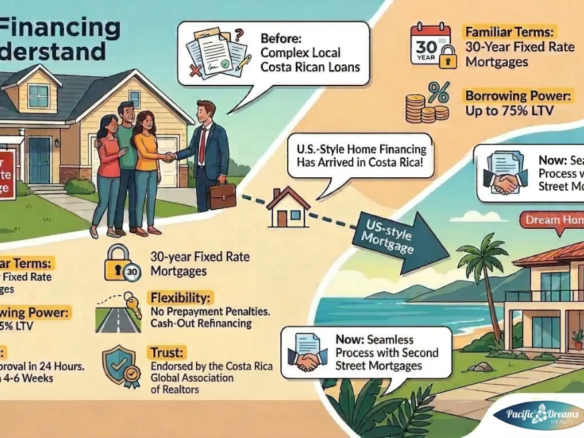
- For Canadian and U.S citizens, Second Street Mortgage is an option in Costa Rica for North American style home loans.
Understanding Seller Financing: Fideicomiso (Trust) vs. Hipoteca (Lien)
- Hipoteca (Lien/Mortgage): The “old way.” The title is in your name with a lien on it. If you default, the seller must go through a slow, expensive judicial foreclosure.
- Fideicomiso (Guarantee Trust): The modern, standard method. The title is in a neutral trust. If you default, the trustee (escrow company) can swiftly transfer the title back to the seller without a court process. This provides maximum security for the seller, making them far more willing to offer financing.
6. Conclusion: Your Next Steps to Owning a Piece of Paradise
Buying property in Costa Rica is a transparent and secure process, if you follow the correct steps. Foreigners have excellent rights, and the legal system is designed to protect titled landowners.
Your path to success relies on building the right team:
- Find a SUGEF-registered and CCCBR/CRGAR-affiliated real estate agent who will act as your buyer’s agent.
- Hire an independent, reputable attorney to conduct thorough due diligence.
- Use a registered escrow agent for all deposits and for managing any seller financing.
Finding all these qualified professionals can be the most stressful part of the process. This is where having an experienced team makes all the difference.
The Pacific Dreams Realty team is experienced, knowledgeable, and registered with both CCCBR and SUGEF, ready to help you through the entire process with the least stress. We are more than just real estate specialists; our team includes a legal department, a property management department, and rental specialists. We go beyond the sale to assist our clients with trusted recommendations for home inspectors, banks, furniture and appliance stores, escrow companies, area information, and more!
By choosing a full-service team, you can confidently navigate every step and make your dream of owning a piece of paradise a reality. Call or WhatsApp +50684470781 or email sales@puravidarc.com



Únete al foro